Skip table of contents

Fixed Income Monitor

AVAILABLE IN: image-20251027-072316.png image-20251027-072231.png

Introduction

The Fixed Income Monitor widget offers a focused view of your portfolio’s exposure to fixed income instruments, helping you analyze allocation, risk and yield characteristics at a glance.

It presents both a table view of key metrics and a breakdown of sector weights, giving you insight into how your fixed income strategy is structured and performing.

What It Shows:

Table View

Provides a summary of fixed income metrics for relevant positions.
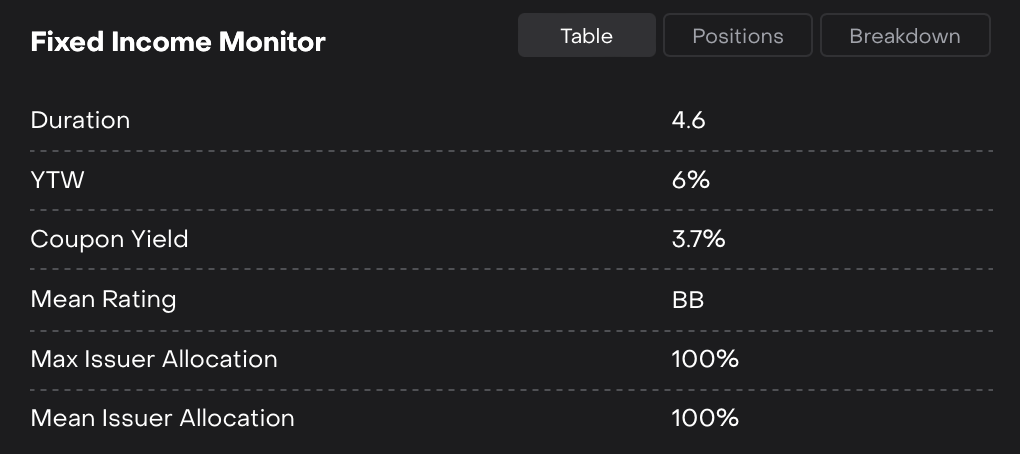
Fixed Income Monitor – Parameter Reference Table

Parameter

What It Means

Why It Matters / How to Use It

Duration

The average time until the portfolio’s fixed income instruments mature.

Indicates interest rate sensitivity—longer durations mean more exposure to rate changes.

YTW (Yield to Worst)

The lowest possible yield assuming the issuer doesn't default.

Helps assess minimum potential return and price risk under worst-case redemption scenarios.

Coupon Yield

The average annual coupon payments as a % of face value.

Useful for evaluating the income-generating capability of the bonds.

Mean Rating

The average credit rating across fixed income positions.

Reflects the credit quality or risk level of the fixed income portfolio.

Max Issuer Allocation

The largest percentage of total AUM allocated to a single issuer.

Helps identify concentration risk—overexposure to a single entity.

Mean Issuer Allocation

The average allocation per issuer within the fixed income portion.

Shows how diversified the bond portfolio is across different issuers.

Each metric (except Mean Rating) is shown both including and excluding cash positions, allowing for more flexible interpretation.

Positions View
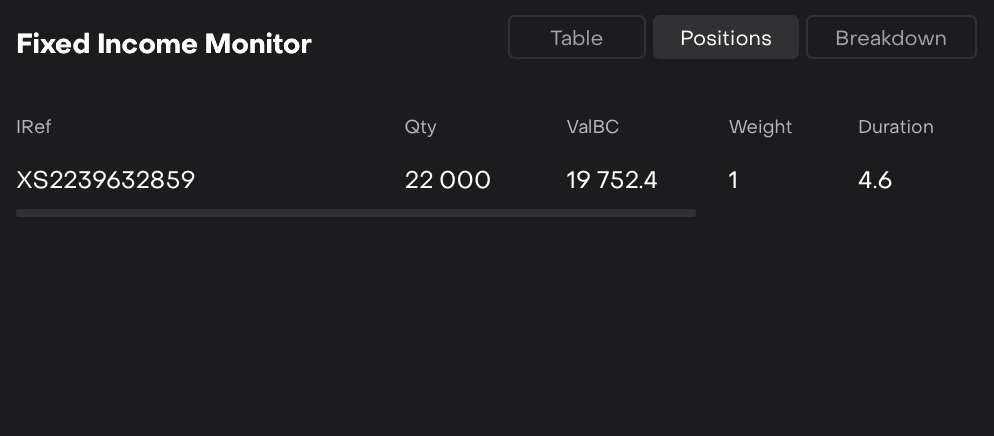
Fixed Income Monitor – Position Parameter Reference Table

Parameter

What It Means

Why It Matters / How to Use It

IRef

Instrument Reference – typically the ISIN or unique ID of the bond (e.g., US00724PAD15).

Identifies the specific bond in the portfolio.

Qty

Quantity of bond units held in the portfolio.

Helps determine exposure size. Larger quantities mean higher allocation or confidence in asset.

ValBe

Market value of the position in base currency.

Shows the current worth of the bond. Used to calculate allocation and performance.

Weight (%)

The percentage this bond represents within the total fixed income portfolio.

Reveals allocation concentration to each bond.

Duration

Time-weighted average maturity (in years), adjusted for cash flow timing.

Indicates the interest rate sensitivity of the bond. Higher = more rate risk.

YTW

Yield to Worst – lowest possible yield assuming earliest callable date.

Shows minimum expected return. Useful for conservative yield forecasting.

Coupon

The bond’s annual interest rate (in %), usually fixed.

Indicates income generation potential from interest payments.

MktPx

Market Price – current trading price of the bond, typically as % of par (e.g., 98.5).

Used to calculate unrealized gains/losses and assess premium/discount status.

Breakdown View

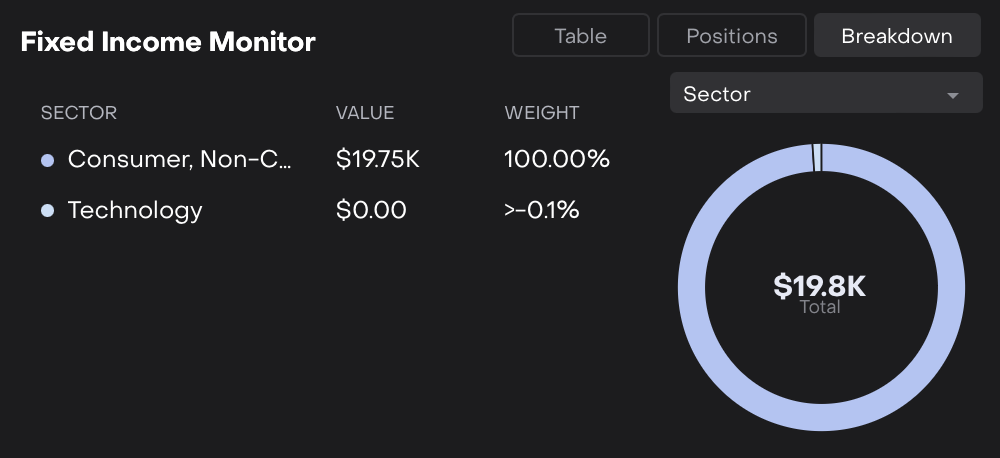
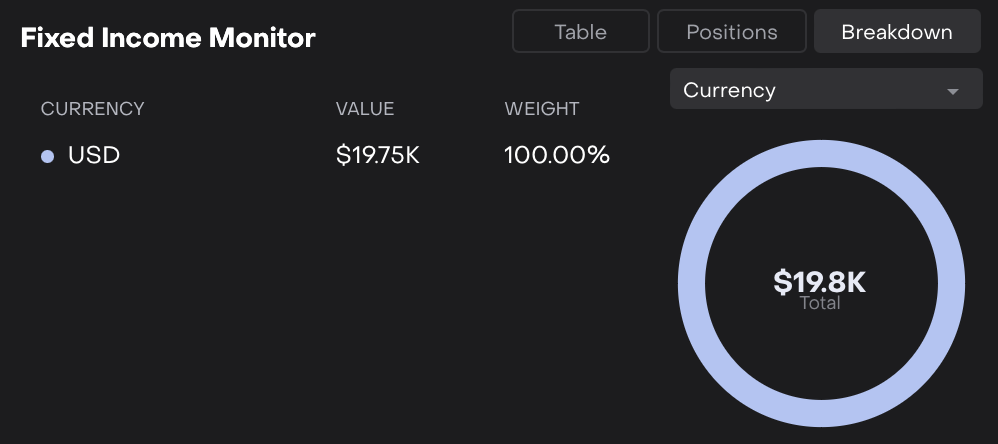
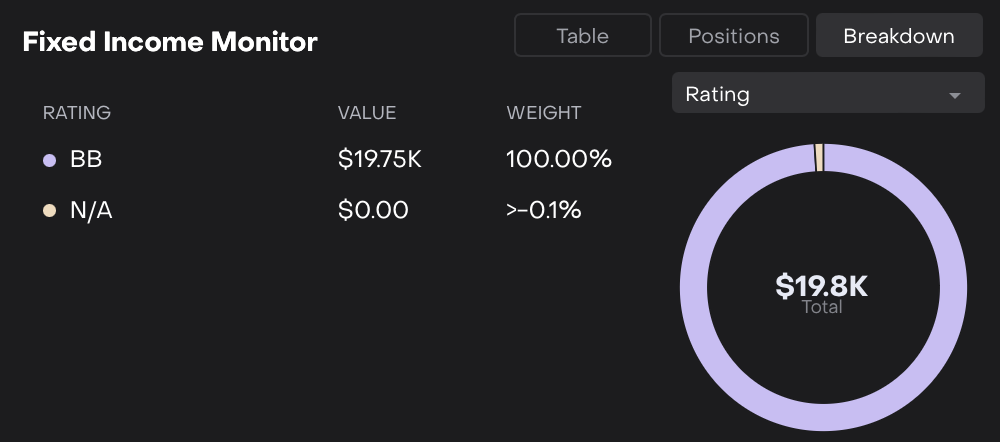
Visualizes the Weight and Value of each Sector, Currency and Rating in the fixed income strategy.

Common Parameters Paired with Breakdown:

Field/Parameter

Definition

Value

The total market value (in base currency) of all fixed income positions within it.

Weight (%)

Percentage of total fixed income allocation that each category represents.

Sector

Currency

Rating

Fixed Income Breakdown – By Sector

Detailed Table here:

Sector

What It Means

Why It Matters / How to Use It

Financial

Bonds issued by banks, insurance firms, and other financial institutions.

Often higher yields; key to monitor due to systemic risk exposure in economic downturns.

Technology

Debt from tech companies (software, hardware, IT services, etc.).

Generally considered growth-oriented; may have lower ratings but higher return potential.

Consumer, Non-Cyclical

Companies producing essential goods like food, healthcare, household items.

Stable and resilient in downturns. Good for defensive fixed income exposure.

Industrial

Bonds from manufacturing, construction, machinery companies.

Sensitive to economic cycles. Monitor for cyclical performance and industrial demand trends.

Communications

Telecom and media companies issuing bonds.

Typically cash-generative businesses, offering a mix of yield and stability.

Utilities

Energy, water, and public service providers.

Regulated and stable—often lower yield, but less credit risk.

Basic Materials

Companies producing raw materials (e.g., mining, chemicals, metals).

Exposed to commodity price fluctuations; may offer higher yield.

Consumer, Cyclical

Auto, travel, luxury goods, and retail.

Volatile based on economic cycles; yields may vary with consumer spending trends.

Energy

Oil, gas, and renewable energy sector companies.

Can be high-yielding; must monitor for commodity-driven volatility and geopolitical risks.

Fixed Income Breakdown – By Currency

Detailed Table here:

Currency

What It Means

Why It Matters / How to Use It

USD

US Dollar-denominated bonds.

Standard in global portfolios; watch interest rate sensitivity to US Fed policy.

EUR

Euro-denominated bonds.

Common in European portfolios; balance currency hedging vs. diversification.

GBP

British Pound.

Relevant for UK-based investments; may require hedging in non-GBP portfolios.

CHF

Swiss Franc.

Often seen as a safe-haven currency; low yields, stable value.

JPY

Japanese Yen.

Useful for low-rate environments; check for currency mismatch risk.

AUD / NZD

Australian or New Zealand Dollar.

Higher yield currencies; popular in carry trade strategies.

Other / N/A

Unclassified or exotic currencies.

Review exposure carefully for liquidity and FX risk.

Fixed Income Breakdown – By Rating

Detailed Table here:

Rating

What It Means

Why It Matters / How to Use It

AAA

Highest possible credit quality. Extremely low risk of default.

Indicates very safe investments. Useful for risk-averse strategies or capital preservation.

AA

Very high credit quality, just below AAA. Low credit risk.

Suggests strong issuers. Balances safety and slightly better yield than AAA.

A

Upper-medium grade. Low risk, but more sensitivity to economic conditions.

Common in diversified portfolios. Balances credit risk and return.

BBB

Lower-medium grade. Still investment-grade, but more vulnerable to downturns.

Often used for moderate-risk yield opportunities. Threshold before becoming high-yield.

BB

Speculative grade (non-investment grade). Higher credit risk.

Higher yield potential, but comes with increased default risk. Used in aggressive strategies.

B and below

Highly speculative to very risky. Significant default probability.

Only suitable for high-risk portfolios. Used selectively for yield chasing.

N/A

No rating assigned. Could be due to private debt, new issues, or data gaps.

Watch this closely, unrated positions may increase portfolio opacity or risk exposure.

Example:

If your total fixed income AUM is $100 million:

  • A BBB rating with $25 million value → Weight = 25%

  • An N/A rating with $10 million value → Weight = 10%

How It Works:

  • Pulls data from fixed income positions across your portfolio.

  • Table values remain constant regardless of the date filter.

  • Breakdown values change dynamically based on the selected date.

  • If no fixed income data is available, the widget is automatically hidden.

Values in this section reflect the selected date from the dashboard filters.

JavaScript errors detected

Please note, these errors can depend on your browser setup.

If this problem persists, please contact our support.