Manage Custom Processes
Introduction
Custom Processes are an integral part of Automation on the platform. With Processes, you can design specialized, automated actions that match your organization's workflows, without manual intervention.
You can use a Process to:
Change or update data automatically
Send targeted notifications
Trigger scripts to perform complex tasks
Prevent records from being created or edited if criteria are not met

Notifications and Processes are linked. A Process is required to execute and deliver notifications on the platform.
🔗 Learn how to set up Notifications, here.
Key Terminologies
Term (A–Z) | Definition |
|---|---|
Action | A task that the Process executes once triggered. Examples include sending notifications, updating fields, running scripts, or sending exceptions. |
Criteria | Conditions that must be met for the Process to run. Multiple criteria are combined using AND logic. |
Field | A specific data point in the Object that the Process can read or update. |
Notification Template | A pre-configured email or push alert that can be executed by a Process. |
Object | The entity the Process works on (e.g., Account, Bank Account, Portfolio, Transaction, Order). |
Process | An automated workflow that triggers actions based on criteria and triggers. Processes are required to execute Notification Templates. |
Recipient | The user, department, role or client who will receive notifications triggered by the Process. |
Script | A set of instructions executed by a Process for advanced actions, such as creating related objects or performing complex calculations. |
Trigger | An event or timing that starts the Process. Examples: Pre-Create, Post-Create, Pre-Update, Post-Update, Create/Update. |
👉 New to some terms? Check out our full Platform Glossary for more.
Permissions Requirement
Platform Name | Permission Level |
|---|---|
Processes | View, Modify, Create |

If you do not see the System Setting option, please contact your Business Admin to grant you the required permission.
🔗 Click here to view more about profile configuration.
Understanding the Process Structure
Every Process you create has a defined structure that tells the platform when to run it, what conditions to check and which actions to perform. Here’s a step-by-step guide on how to set up a process.
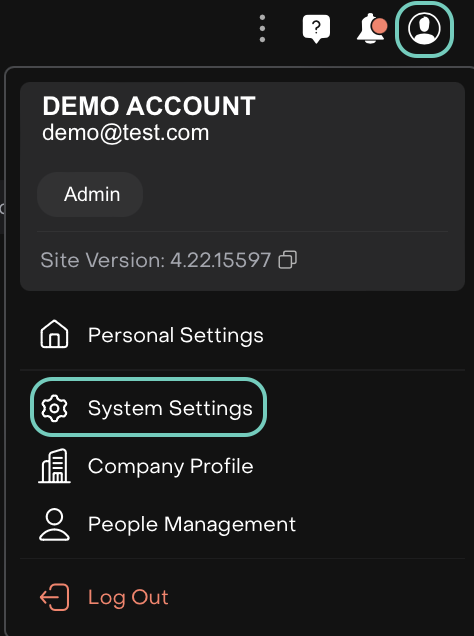
Go to User Profile Settings and click on System Settings.
Find and select Processes tab.
Click the
+icon located on the right side of the Processes page.

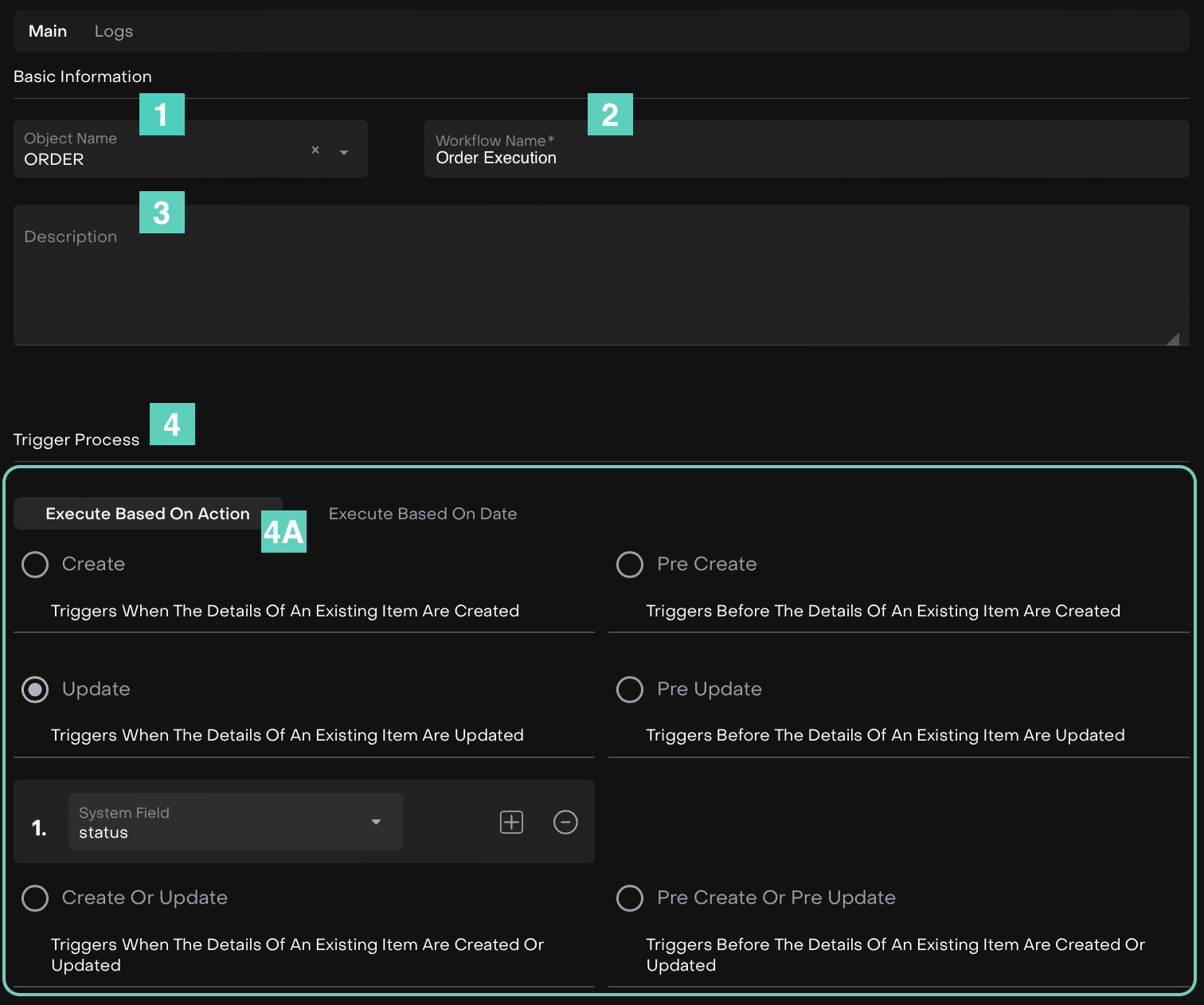
A form opens. Fill in all the required fields(*).

Not all platform objects are available to build Processes. If you do not see the object you need, please submit a request to Support to have the required object delivered.
Platform Rule for Positions:
Position Processes require a Notification to exist first. The platform checks for an existing Notification with the same Object Type and Process and blocks duplicates.
It is recommended to avoid using Pre-Create and Pre-Update actions in day-to-day processes. In most cases, these Pre-Actions are intended for system processes added to the platform by the development team.

The expression in the Date field is in UTC, so make sure to adjust the Hours value accordingly.
Use a cron expression to schedule the process based on the Date field. For example, 0 00 * * * this process runs every day at 12:00 AM (midnight).
Here’s how to use cron expressions:
* means “every”.
Example: * * * * * → run every minute.
, means a list of specific values.
Example: 0,30 * * * * → runs at minute 0 and 30.
- means a range.
Example: 9-17 * * * * → runs every hour from 9 to 17.
/n means “every n units”.
Example: */10 * * * * → runs every 10 minutes.
Sr No. | Field | Description |
|---|---|---|
1 | Object Name(*) | The type of record the Process will work on. Here’s the list:
|
2 | Workflow Name(*) | A unique name for your Process so you can identify it later. |
3 | Description | A detailed note/summary for the process. |
4 | Trigger(s) | The event(s) that start the Process (e.g., when a record is created, updated or at a scheduled time). Learn more on Trigger Types. |
4A | Select the relevant action from the dropdown during setup. | |
4B | Set the date or recurring schedule using configuration. | |
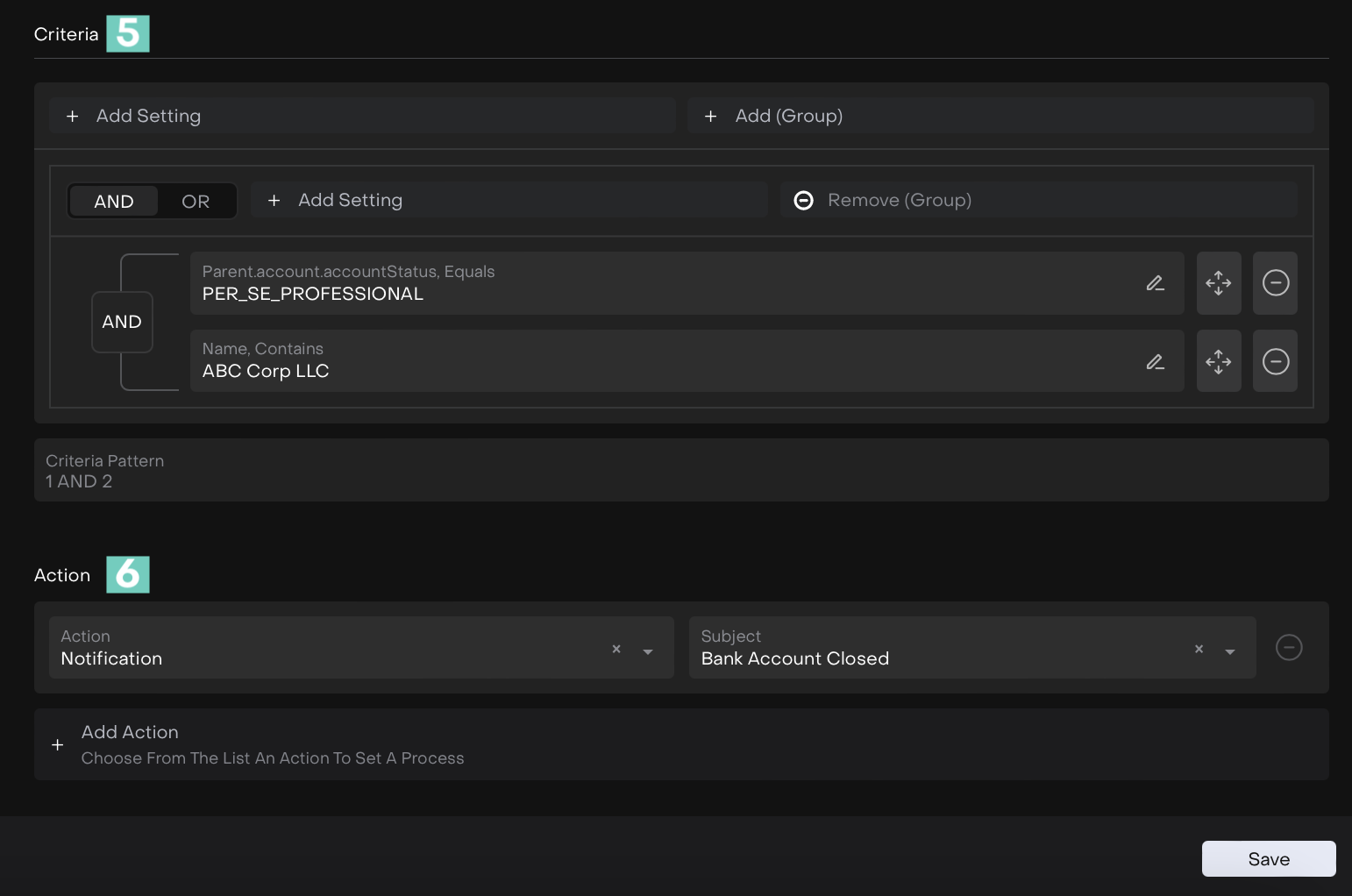
5 | Criteria | Use Add Group or Add Setting to define your filter conditions. If you set multiple criteria, all must be met (AND condition) for the process to run.
Learn more on Criteria Options. |
6 | Action(*) | The tasks the Process will perform. Learn more on Action Types. |
If the Process uses an Email Notification, make sure the Email Template is also active.
If the Process uses a Script, ensure it is available and configured.
Trigger Types
To execute the process it is necessary to select an Action or time when process has to be started. Triggers decide when your Process will run.
When Object Name is set to Position, the Execute Based On Action trigger is not available.
Criteria Options
It defines the conditions a record must meet to trigger the process, based on text, numbers, other fields or empty values.
For Date-type system fields, turning ‘ON’ the Custom Date toggle will show only the operators available for customization.
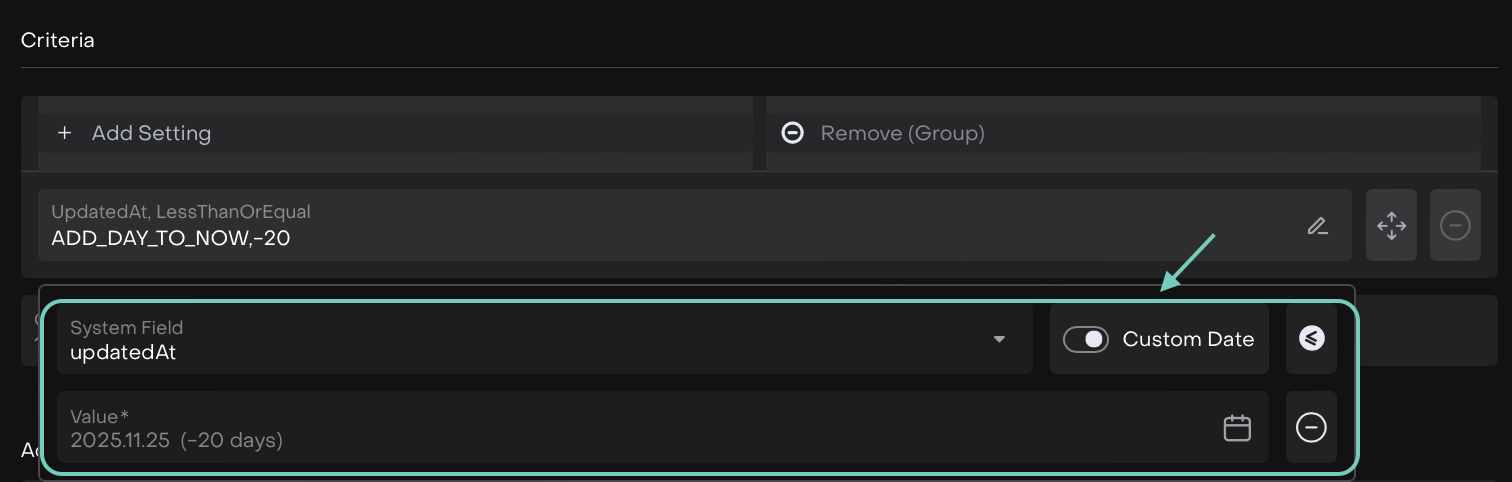
On Processes Tab
Action Types
Once your Process is triggered and all criteria match, the selected actions are executed in the order they appear.
Notifications for Position:
For the Position object, Actions work differently. You can select Notification under Actions only if a Notification Template already exists for the Position object type.
If no Notification exists for Position:
The Notification Action will not appear or cannot be selected.
As a result, you cannot build a Position Process that sends notifications until you create the corresponding Notification first.
Action | What It Does | Extra Setup Required? |
|---|---|---|
Notification | Sends an email notification. | Yes – Notification Template must be configured and active. Notifications alone do not run; they must be linked to a Process. |
Field Update | Changes the value of a field in the selected Object. | No – but you can only update fields in the same Object, not related Objects. |
Exception | Stops record creation or update if criteria are met (used with Pre-Create/Pre-Update). | Yes – An exception text message is mandatory to input. |
Script | Executes a predefined script for complex actions (e.g., creating related objects, advanced logic). | Yes – Contact the Reluna Support Team. |
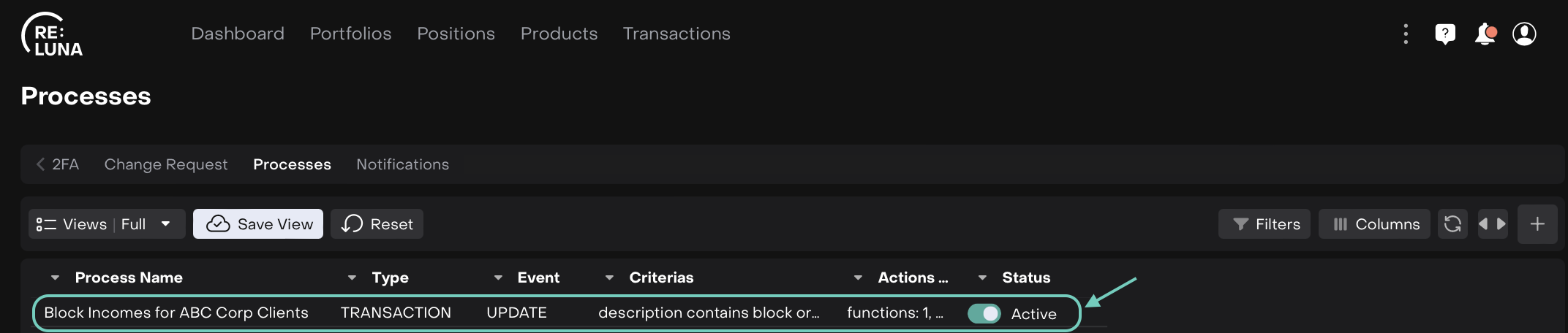
Click Save to store the configuration and your Process must be Active for it to work.
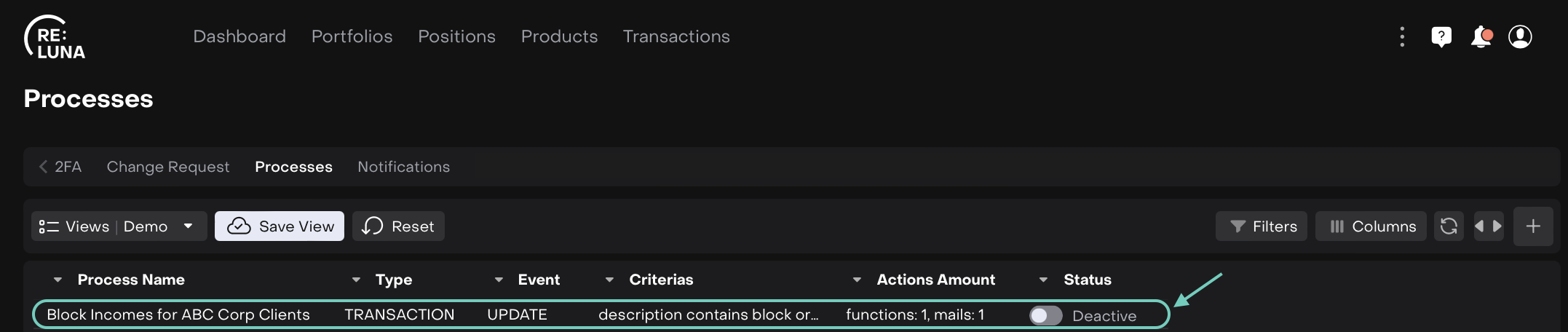
Or, once created, you can toggle ‘Off’ to Deactivate it.
Why Your Process Might Not Be Working
If your Process is not running as expected, check the following:
✅ The Process is Active.
✅ The correct Trigger is selected.
✅ Execution Based on Date is filled in as a cron expression.
✅ The record(s) match all criteria exactly as defined.
✅ For Notification actions, the Notification Template is active.
✅ For Script actions, the script is available and correctly linked.
If all checks are correct and the Process still isn’t working, contact Reluna Support.